Open mobile app

Customer supportTypically replies within a few minutes
Need help with placing an order, delivery, or something else? Start with our Help Page — or message us anytime for support.
NOT AVAILABLE TO SHIP - In-store only
Overview:
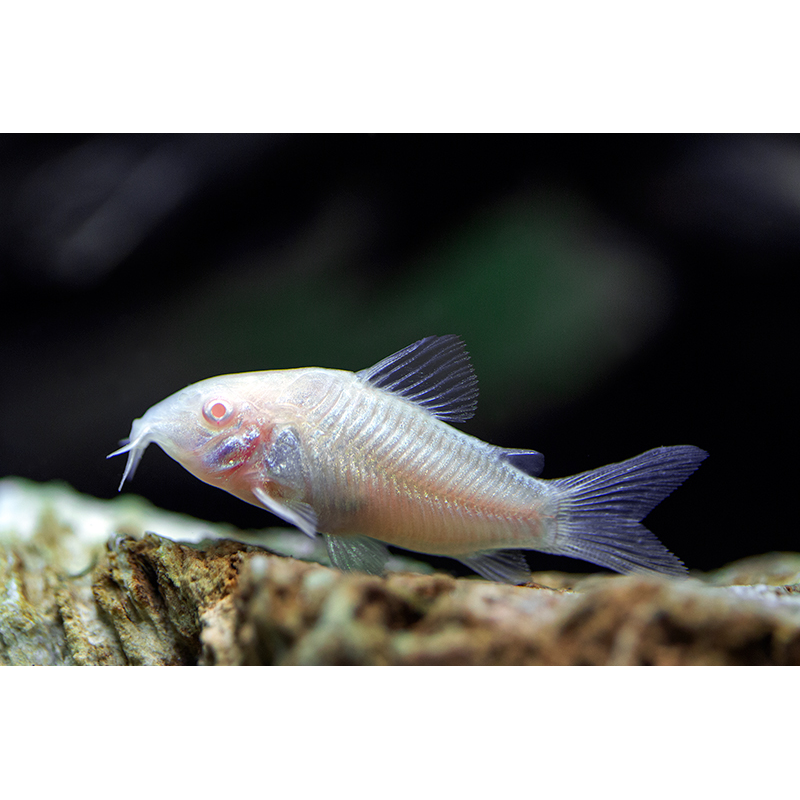
The Albino Corydoras (often just called the Albino Cory) is one of the most popular bottom-dwelling catfish in the world. While several Corydoras species have albino forms, the vast majority sold in the trade are variants of the hardy Bronze Cory (Corydoras aeneus). They feature a pearlescent, pinkish-white body with a subtle metallic yellow sheen and glowing ruby-red eyes. They possess armor-like scales and multiple sets of sensitive whiskers, called barbels, around their mouths to help them sift through the bottom of the tank.
Origins:
While the base Bronze Cory is natively found widespread across South America (from Colombia down to Argentina), the Albino variety is explicitly farm-bred for the aquarium trade. Like all corys, they can occasionally be seen darting rapidly to the surface to take a gulp of atmospheric air, using a specialized vascular intestine to process the oxygen—a wild survival adaptation for low-oxygen waters.
Personality:
Albino Corys are incredibly peaceful, busy, and entertaining to watch. They are highly social team players that spend their entire day playfully waddling along the bottom of the tank, industriously vacuuming up leftover food. They display zero aggression and are completely safe with even the tiniest freshwater dwarf shrimp.
Care Level: Very Easy
Temperament: Peaceful and Community-Friendly
Diet: Omnivore Scavenger (Sinking catfish pellets, crushed flakes, and frozen treats like bloodworms or brine shrimp. Note: They cannot survive on just "tank waste"—they require targeted feeding!)
Max Size: 5 – 7 cm
Family: Callichthyidae
Tank Size: 40 Litres minimum for a small group; 80 Litres or more is preferred to give them a wide floor space.
Temperature: 21°C – 26°C
pH: 6.0 – 7.5
Should be kept in groups? Yes. They are strictly a schooling species and should be kept in a group of at least 5 to 6. Watching a coordinated pack of corys "dance" along the front glass or scavenge together is one of the best sights in the hobby.
Crucial Setup Note: Because Albino Corys spend all their time pushing their faces into the substrate to look for food, you must use smooth sand or fine, rounded gravel. Coarse or sharp gravel will slice their delicate barbels (whiskers), leading to painful infections and making it impossible for them to feed properly.
Need help with placing an order, delivery, or something else? Start with our Help Page — or message us anytime for support.