Open mobile app

Customer supportTypically replies within a few minutes
Need help with placing an order, delivery, or something else? Start with our Help Page — or message us anytime for support.
NOT AVAILABLE FOR SHIPPING - In-store Only
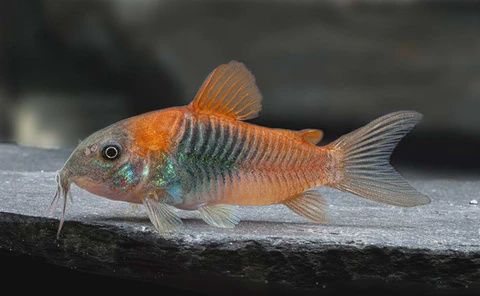
Overview: When looking for an "Orange Corydoras," you will generally cross paths with one of two spectacular, highly sought-after species in the hobby: the Orange Laser Cory (CW010) or the Venezuelan Orange Cory (Corydoras venezuelanus).
The Orange Laser (CW010): Features a striking, metallic brownish-green body highlighted by a brilliant, almost neon-fluorescent bright orange stripe running along its spine that looks exactly like a glowing laser beam.
The Venezuelan Orange: Features a rich, deep burnt-orange to amber body coloration on its head and tail, contrasted by a prominent, dark metallic-green block or patch on its flanks.
Both possess the classic, lovable Corydoras build: an armor-plated body, a flat underbelly, and a downward-pointing mouth framed by sensitive sensory barbels.
Origins: The Venezuelan Orange is native to specific river systems in Venezuela (like the Río Cabriales), thriving in heavily vegetated, slow-moving streams. The Orange Laser (CW010) hails from the Amazon basin in Peru, often found in clear-water tributaries surrounded by dense rainforest canopy.
Personality: Like their Panda cousins, Orange Corydoras are boundlessly cheerful, energetic, and completely peaceful. They are active, daylight-loving bottom-dwellers that spend their time playfully sifting through the sand like little underwater vacuum cleaners. They have a highly gregarious, tight-knit group dynamic, frequently exploring the tank shoulder-to-shoulder or lounging together on flat leaves.
Care Level: Easy
Temperament: Extremely Peaceful (100% community and dwarf shrimp safe)
Diet: Omnivore/Scavenger (They require dedicated feeding! Give them high-quality sinking pellets, shrimp wafers, and plenty of live or frozen treats like bloodworms, tubifex, and brine shrimp).
Max Size: 5 – 6 cm
Family: Callichthyidae
Tank Size: 60 – 75 Litres minimum. (Prioritize a tank with maximum floor space/length over height).
Temperature: 22°C – 26°C
pH: 6.0 – 7.5
Should be kept in groups? Yes, strictly. They must be kept in a social school of at least 6 or more. If they are isolated, they will become deeply stressed, lose their brilliant orange color, and hide constantly.
The Sand Mandate: Because they actively push their snouts deep into the floor to search for food, you must use smooth, fine sand. Coarse or sharp gravel will slice their delicate barbels, leading to painful infections, stress, and starvation.
Surface Access: Like all Corydoras, they possess a modified intestine allowing them to swallow atmospheric air. Ensure your tank has open space at the water's surface so they can safely dash up for a quick gulp of air whenever they need it.
Need help with placing an order, delivery, or something else? Start with our Help Page — or message us anytime for support.